

Curriculum map and pacing guide
Welcome to the Woodshop
Unit 1 · For parents and teachers · Version 1, October 25, 2026
Family view. A homeschool family, or a parent helping at home. 4 sections you can skip are tucked away.
All four lessons and the capstone are built. Every lesson works on screen by itself, and every word is read out loud.
1Cover and At a Glance#
For everyone
| Big idea | A tradesperson is a problem-solver. They assess a situation, figure out the problem, and come up with a solution. |
|---|---|
| Ages | 7 to 13. Foundations is ages 7 to 10. Builder is ages 11 to 13. |
| Stops | Four lessons and a capstone. |
| Time on screen | About 11 to 14 minutes a stop. About an hour for the whole unit. |
| Time hands-on | Optional. A short thing to try at home after each lesson. The capstone's cardboard build takes 20 to 40 minutes. |
| What you buy | Nothing. Unit 1 is free with a free family account. |
| Tools | None. Unit 1 is a mindset unit. The first tools come in Unit 2, each taught in the lesson where it first appears. |
| The method | Think, Plan, Build, Test. The pros call it Assess, Plan, Build and Evaluate. Taught in Lesson 4, used in the capstone, and used in every capstone after. |
| Capstone | The Birdhouse Design Challenge, in cardboard. A drawing counts, all the way to the badge. |
| Badge | Problem Solver, earned by mastery. |
| Shop Tips | Five, one a stop, saved in the builder's Shop Notes. |
The five stops

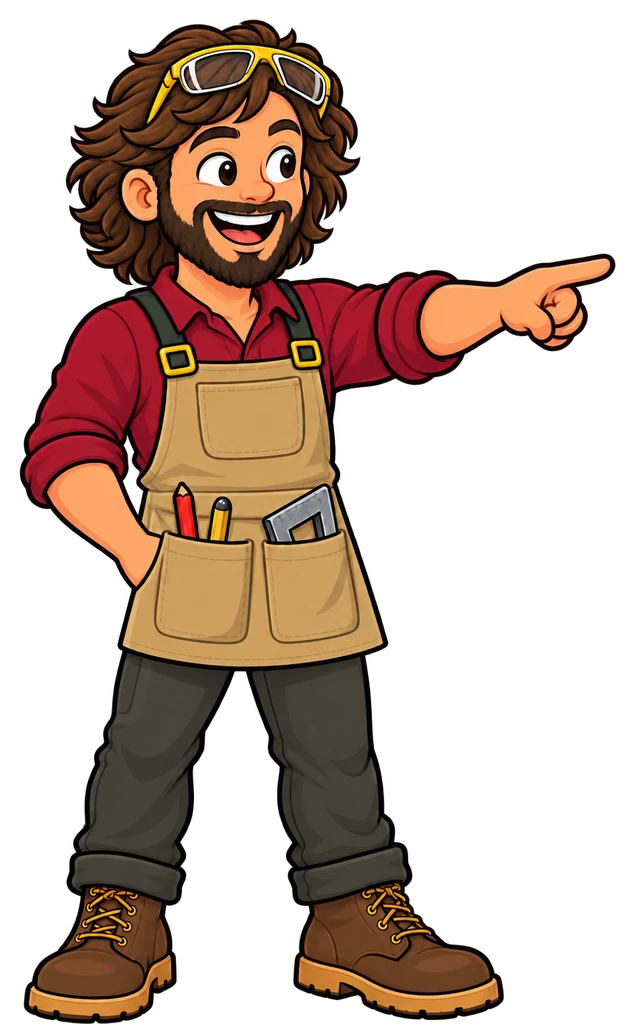 Stop 1
Welcome to the Woodshop
The new builder's family: is there a hook for one more builder?
 Stop 2
What Is Woodworking?
Ava, whose grandpa made her a duck step stool
 Stop 3
The Trades and the People Who Do Them
Grandpa Stu, who just moved into an old farmhouse
- Stop 4
The Defining Skill: Problem-Solving
Theo, whose shoes always end up in a pile
- Capstone
The Birdhouse Design Challenge
Nana June, who watches birds from her kitchen window
2Who reads what#
For everyone Your row is marked. The view switch at the top shows your parts.
| You are | Read these | Skim or skip |
|---|---|---|
| A homeschool family, or a parent helping at home | Sections 1, 2 and 3 (the parts marked For families), your pacing track in 4, the family box on each stop page in 5, the cutting rules in 8, the materials in 10, and the family letter in 11 | The teacher boxes, the standards page in 9 |
| A classroom teacher | Sections 1 to 4 for the plan, 5 for each stop, 6 and 7 for assessment and supports, 9 for standards | The family callouts, unless you send them home |
| A co-op host | Sections 1, 4 (Track C), 8 (the cutting rules), 10 (materials) and the printables | The standards page, unless your co-op reports them |
| The parent or teacher at the capstone | The capstone stop page, "Can I cut today?" (printable 9) and the build card (printable 10) | Everything else can wait |
Words used in this guide:
- Stop: one lesson, or the capstone.
- Foundations: ages 7 to 10. The animated lessons are written for them.
- Builder (the age group): ages 11 to 13. Same stops, a higher standard and more of the why.
- Core: the on-screen lesson. Optional: the things to try at home, the capstone's cardboard build and the extensions.
- The front room and the shop floor: the two rooms of the woodshop. The front room has the jobs board, the plans board, the badge shelf and the arcade. The shop floor is where the crew builds.
3Big idea, transfer goal and essential questions#
For everyone
For teachers This page follows stage 1 of Understanding by Design (Wiggins and McTighe): results first, then the evidence, then the plan.
Transfer goal. On their own, when something at home or in the woodshop isn't working, students find the real problem first, then plan, build and test a fix. They use the same four steps in every capstone after Unit 1.
Students will understand that
- A tradesperson is a problem-solver. Every trade shares that one skill.
- Woodworking is making useful things out of wood. Useful means it does a job. A woodworker cuts wood into pieces, then joins them together.
- Each trade has its own tools, but every trade measures, plans and works safely. So what you learn in the woodshop goes with you, to any trade.
- Good builders find the real problem first, plan before they build, and test what they made. A test that says "not yet" sends you back to think again, and that is part of the work.
- Pros often make a template first, from a cheaper material. A prototype is a first model you learn from.
Essential questions
- What is the real problem here, and how do I know?
- Why do builders plan before they build?
- What do all the trades share, even with different tools?
- How do I know my build works?
Students will know
- The six crew builders and what each one does.
- The six places in the front room and what each is for.
- What woodworking is, and what useful means.
- That plywood is thin layers of wood glued together, the layers crossing, which makes it strong.
- That pocket holes hide the screws that join a stool's steps to its sides.
- What a trade is, and what six trades fix: electrician, plumber, mason, welder, HVAC tech and roofer. And Mr. Spinozzi's own trade, carpenter.
- The four steps: Think, Plan, Build, Test. And the pro words: Assess, Plan, Build, Evaluate.
- The three ways to plan a build: write your ideas down, draw a sketch, or make a template.
- What a bird needs from a birdhouse: a roof, a small door, a perch and a seed tray.
- The five Shop Tips (one on each stop page).
- Shop words (on each stop page, and printable 3).
Students will be able to
- Find who does what on the crew.
- Find the parts of a wooden step stool, and say how its pieces join.
- Match six fixes to the trade that does each one.
- Put the four steps in order on a real job.
- Find the real problem in a small problem at home, and tell a plan to fix it.
- Make a plan for a birdhouse: a checklist, one extra and a drawing with labels.
- Build a cardboard birdhouse from a build card, or draw it.
- Check it against the checklist, and name one thing to change next time.
Predictable misunderstandings (as the lessons answer them)
| Students may think | The truth, as the lessons teach it | Where it is fixed |
|---|---|---|
| A good builder starts building right away. | Leo wants to build Theo a giant shoe box right now. Mia stops him: find the real problem first. | Lesson 4, The Huddle |
| The problem is what the letter says. | Theo thinks his shoes get lost. Gus looks closely: no shoe is lost, they just have no home. | Lesson 4, Look |
| If a test fails, I failed. | If it doesn't work, you go back and think again. On the checklist, an empty star means "not yet", never a fail. | Lesson 4 Look; capstone Test |
| Every trade is totally different. | Each trade has its own tools, but every trade measures, plans and works safely. | Lesson 3, Write Back |
| Asking for help means you can't do it. | Good builders know which jobs need a different trade. Asking for help is a pro move. | Lesson 3, Shop Tip |
| You can see how something was made from the top. | Look underneath. The stool's screws hide in pocket holes, and the underside isn't painted. | Lesson 2, game and Shop Tip |
| Plywood is one solid board. | Plywood is thin layers of wood, glued together. The layers cross, so it's strong. | Lesson 2, game |
| A plan has to be a perfect drawing. | There are three ways to plan: write your ideas, draw a sketch, or make a template. Labels help you remember, and spelling doesn't have to be perfect. | Capstone, Plan |
| A model has to be finished to count. | Mr. Spinozzi's kids' cardboard birdhouse isn't colored in yet. A builder can always add more. | Capstone, The Huddle and Test |
| Models are a waste of time. Go straight to wood. | Cardboard mistakes are free. Wood mistakes cost money. | Capstone, Shop Tip |
Stage 2, the evidence, in one line. The performance task is the capstone birdhouse, planned with a checklist and a drawing, built from cardboard or drawn, and checked line by line against the checklist. Other evidence: the one game in each lesson, the warm-up questions at the start of Lessons 2 to 4, the things to try at home, the observation checklist and the reflection slips. Section 6 has the detail.
Stage 3, the plan, in one line. Each lesson is one job by letter, on the same eight beats: Arrive, The Letter, The Huddle, Look, Play and Find It (one game), Write Back, Try It at Home and Job Done. The capstone keeps Arrive, The Letter, The Huddle and Write Back, and puts the four steps in the middle: Think, Plan, Build and Test.
4Pacing guide#
For everyone
Count your days first. Before you start, count the sessions you really have. Take out holidays, test days and the weeks that always go sideways. Then pick a track.
Core and optional. Core is the on-screen lesson, about 11 to 14 minutes. Optional is everything else: the things to try at home, the cardboard build and the extensions. If time is short, keep the core. The capstone's on-screen steps earn the badge with a drawing in place of the build.
The capstone runs in two sittings. The first sitting runs from Arrive to the build card, about 11 minutes, including Mr. Spinozzi's 97 second video about templates. Then the builder builds, away from the screen, for 20 to 40 minutes. The lesson waits at Build. The second sitting, about 3 minutes, is Test, Write Back and Job Done. The build can happen the same day or another day.
Estimate The hands-on minutes below are estimates. They will be checked and updated after families try the lessons.
Track A: one stop a week (5 weeks). For homeschool families, a weekly class or special, and a co-op that meets weekly. One session a week. In week 5, one long session, or two short ones a few days apart.
| Week | Stop | What happens | Session length |
|---|---|---|---|
| Week 1 | 1 Welcome to the Woodshop | Lesson 1. Tell someone about the crew, about 5 minutes. | 15 to 20 minutes |
| Week 2 | 2 What Is Woodworking? | Lesson 2, with two of Mr. Spinozzi's own videos. Wood Hunt, about 10 to 15 minutes, with a parent or teacher for the look underneath. | 25 to 30 minutes |
| Week 3 | 3 The Trades and the People Who Do Them | Lesson 3. Trade Spotting, about 10 minutes. | 20 to 25 minutes |
| Week 4 | 4 The Defining Skill: Problem-Solving | Lesson 4. Fix-It Hunt, about 10 minutes. Save an empty box for next week. | 20 to 25 minutes |
| Week 5 | C The Birdhouse Design Challenge | The capstone, about 11 minutes on screen, then about 3. Draw the build plan, about 10 to 15 minutes. Build the birdhouse, 20 to 40 minutes. | 45 to 70 minutes, or two sessions |
Track B: a daily sprint (1 week, 5 or 6 days). For a week-long school unit, a summer camp or a homeschool block. One stop a day. The capstone takes day 5, and day 6 if the build needs more time.
| Day | Stop | What happens | Session length |
|---|---|---|---|
| Day 1 | 1 Welcome to the Woodshop | Lesson. Tell someone about the crew. | 15 to 20 minutes |
| Day 2 | 2 What Is Woodworking? | Lesson. Wood Hunt. | 25 to 30 minutes |
| Day 3 | 3 The Trades and the People Who Do Them | Lesson. Trade Spotting. | 20 to 25 minutes |
| Day 4 | 4 The Defining Skill: Problem-Solving | Lesson. Fix-It Hunt. Gather the boxes and the things on the build card. | 20 to 25 minutes |
| Day 5 | C The Birdhouse Design Challenge | First sitting and the build. Think, Plan (the checklist and the drawing), the cut question, the build card. Build. | 45 to 60 minutes |
| Day 6, if needed | C The Birdhouse Design Challenge | Second sitting. Finish the build. Test, Write Back, Job Done. Badge. Certificate. | 15 to 45 minutes |
Track C: a class or co-op block (5 or 6 meetings). For a class or co-op that meets once a week for 45 to 60 minutes, 6 to 10 kids. The lesson plays on a shared screen, and each kid can replay it at home.
| Meeting | Stop | What happens | Session length |
|---|---|---|---|
| Meeting 1 | 1 Welcome to the Woodshop | Meet the Crew cards in pairs (printable 1). Each kid says which builder they are most like, and why. | 45 to 60 minutes |
| Meeting 2 | 2 What Is Woodworking? | A Wood Hunt in the room: five things made of wood. The teacher turns one chair or table over to look underneath. Look only. | 45 to 60 minutes |
| Meeting 3 | 3 The Trades and the People Who Do Them | Who Do You Call? match cards (printable 6). Trade Spotting in the room: a light switch, a door, a pipe or a sink. Look, but don't touch. | 45 to 60 minutes |
| Meeting 4 | 4 The Defining Skill: Problem-Solving | The Four Steps card (printable 2). A Fix-It Hunt in the room, in pairs. Ask each family to send in an empty box. | 45 to 60 minutes |
| Meeting 5 | C The Birdhouse Design Challenge | Think and Plan on the shared screen. Each kid draws a plan (printable 8). The teacher answers the cut question for the class. Build. | 45 to 60 minutes |
| Meeting 6, if needed | C The Birdhouse Design Challenge | Finish the builds. Test each one with Mia's checklist (printable 7). Write Back and Job Done on the shared screen. Certificates. | 45 to 60 minutes |
Track C: the sample block
A sample block
| Minutes | What happens |
|---|---|
| 0 to 5 | Warm-up (from meeting 2 on): the kids say last time's Shop Tip out loud. |
| 5 to 18 | The lesson on the shared screen. Take turns on the taps. |
| 18 to 23 | Say it back: the game's questions out loud (printable 16). |
| 23 to 40 | The thing to try at home, done in the room (below). |
| 40 to 45 | Reflection slips. Put everything back where it goes. |
Builder (ages 11 to 13)
Builders play the same lessons today. Builder versions of each lesson come after the Foundations units are finished. For now, ask a Builder for the harder checklist in the capstone and the Builder goals on each stop page.
Foundations (ages 7 to 10)
The animated lessons are written for them. A drawing counts, all the way to the badge.
5One page per stop#
For everyone Each stop page has a family box at the top and a teacher box below it.
Welcome to the Woodshop
Led by Leo, with Mr. Spinozzi. Built
For teachers
| The job | The new builder's family: is there a hook for one more builder? |
|---|---|
| Minutes | 11 minutes on screen |
| Where | Arrive, The Letter and The Huddle in the front room; Look at the hook wall; the game on the shop floor; Write Back at the hook wall |
| The game | Find the builder: tap who does what |
| The thread | Belonging. The builder joins the crew, as its seventh member. |
| Shop Tip | "Write it down right away. Real builders write numbers and ideas down fast. Sometimes right on the wood! If it's only in your head, it can slip away." |
Goals: I can...
- name the six builders and say what each one does.
- find the jobs board, the badge shelf and Shop Notes.
- say what a woodshop is.
- say which crew skill I'm strongest in, and which I want to grow.
- explain how a job moves through the woodshop: a letter on the jobs board, the work, the letter back.
- tell a younger kid what each place in the front room is for.
Foundations, ages 7 to 10. Switch to Builder at the top for ages 11 to 13.
Builder, ages 11 to 13. A written Builder page for this stop is planned, not yet written.
At home (optional)
- Level 1 Tell someone about the crew, about 5 minutes. No materials.
Standards
The whole stop page, in the guide's words
For teachers
| The job | The new builder's family: can their kid join the crew, and is there a hook for one more builder? |
|---|---|
| Minutes | 11 on screen |
| Where | Arrive, The Letter and The Huddle in the front room; Look at the hook wall; the game on the shop floor; Write Back at the hook wall |
| Look | The front room tour: six places glow, and Leo says what each is for (the jobs board, the arcade, the badge shelf, Shop Notes, the plans board, the portfolio). Then the hook wall: tap a tool belt, and its builder comes in and says two lines of their own. |
| The game | Find the builder, five one-tap rounds. Leo says what a builder does, and the kid taps that builder: Mia (keeps the crew safe), Dex (measures everything), Rosa (draws every plan), Gus (knows a lot about wood), Hana (puts the pieces together). A wrong tap gets Leo's clue: the thing in that builder's belt. |
| The thread | Belonging. The builder joins the crew, as its seventh member. |
| The mark | The apron on hook seven, in the color the kid picked, with their name on the tag. |
| Shop Tip | "Write it down right away. Real builders write numbers and ideas down fast. Sometimes right on the wood! If it's only in your head, it can slip away." |
Goals
| Foundations (7 to 10): I can... | Builder (11 to 13): I can... |
|---|---|
| name the six builders and say what each one does. | say which crew skill I'm strongest in, and which I want to grow. |
| find the jobs board, the badge shelf and Shop Notes. | explain how a job moves through the woodshop: a letter on the jobs board, the work, the letter back. |
| say what a woodshop is. | tell a younger kid what each place in the front room is for. |
Shop words
| Word | Plain meaning |
|---|---|
| Woodshop | A place where builders make things from wood. |
| Jobs board | Where each job is pinned up. Every job comes in as a letter. |
| Shop Tip | A trick real builders use. |
| Shop Notes | The notebook where your Shop Tips are saved. |
| Plan | A drawing that shows what to build, step by step. |
| Portfolio | A binder that shows off things builders made. |
| Tool belt | Holds your tools, so your hands stay free. |
| Apron | Keeps dust and paint off your clothes. |
Safety note. No tools in this lesson. Mia's hello says every belt has safety glasses in the front pocket, to keep flying bits of wood out of your eyes. The shop safety lessons start in Unit 2.
At home
Level 1: Tell someone about the crew (no materials, about 5 minutes)
- Name all six builders.
- Say which builder you are most like, and why.
Materials. None.
What to look for (mostly recall and choices)
| Kind | Evidence |
|---|---|
| Do | Tells someone at home about the crew, with a reason for the builder they are most like. |
| Apply | Finds the right builder in all five rounds of the game. |
| Recall | Names the six builders and one thing each one does. |
What Is Woodworking?
Led by Leo, with Mr. Spinozzi and Hana. Built
For teachers
| The job | Ava, whose grandpa made her a duck step stool |
|---|---|
| Minutes | 13 minutes on screen |
| Where | All in the front room. The crew roll in a cart with a screen, and the videos and photos play on it. |
| The game | Find the parts: tap the part of the stool |
| The thread | A woodworker solves a problem with wood. Ava couldn't reach the sink, so her grandpa built a stool. |
| Shop Tip | "Want to see how something was made? Look underneath a chair or a drawer. You'll see how the builder put it together." |
Goals: I can...
- say what woodworking is, and what useful means.
- find the stool's feet, steps, sides and pocket holes.
- say how a woodworker makes something: cut pieces, then join them.
- explain why crossing the layers makes plywood strong.
- explain why the feet stick out wide.
- look underneath a piece of furniture and say how its pieces join.
Foundations, ages 7 to 10. Switch to Builder at the top for ages 11 to 13.
Builder, ages 11 to 13. A written Builder page for this stop is planned, not yet written.
At home (optional)
- Level 1 Go on a Wood Hunt, about 10 to 15 minutes. No materials. Look underneath one thing with a parent or teacher.
Standards
The whole stop page, in the guide's words
For teachers
| The job | Ava: what is woodworking, and how did her grandpa make her duck step stool? |
|---|---|
| Minutes | 13 on screen, including about 4 minutes of Mr. Spinozzi's videos |
| Where | All in the front room. The crew roll in a cart with a screen, and the videos and photos play on it. |
| The Huddle | Leo asks, Mr. Spinozzi answers: woodworking is making useful things out of wood; people have built with wood for thousands of years; useful means it does a job; a woodworker cuts wood into pieces, then joins them together. A short video shows where he works. |
| Look | Mr. Spinozzi's build diagnosis of the stool, one video of about 3 minutes and 20 seconds. Hana stops it twice: once on the word diagnosis, once on glue. Nothing to tap. |
| The game | Find the parts, five one-tap rounds on two photos of the stool, a review of the video. Which part keeps it from tipping (the feet); where the screws hide (the pocket holes); where you see plywood's layers (an edge); which part wasn't painted (the underside); which piece was cut into a duck shape (a side). |
| The thread | A woodworker solves a problem with wood. Ava couldn't reach the sink, so her grandpa built a stool. |
| Shop Tip | "Want to see how something was made? Look underneath a chair or a drawer. You'll see how the builder put it together." |
Goals
| Foundations (7 to 10): I can... | Builder (11 to 13): I can... |
|---|---|
| say what woodworking is, and what useful means. | explain why crossing the layers makes plywood strong. |
| find the stool's feet, steps, sides and pocket holes. | explain why the feet stick out wide. |
| say how a woodworker makes something: cut pieces, then join them. | look underneath a piece of furniture and say how its pieces join. |
Shop words
| Word | Plain meaning |
|---|---|
| Woodworking | Making useful things out of wood. |
| Useful | It does a job for you. |
| Woodworker | Someone who cuts wood into pieces, then joins them together. |
| Build diagnosis | Finding out how something was made. |
| Plywood | Thin layers of wood, glued together. The layers cross, so it's strong. |
| Pocket holes | Holes on the underside where the screws hide. The screws join the steps to the sides. |
| Wide base | Feet that stick out wide, so the stool doesn't tip. |
Safety note. No tools in this lesson, and no line asks a kid to drill or drive a screw. Pocket screws are a skill for ages 11 to 13, much later. The Wood Hunt says look only, and never take anything apart.
At home
Level 1: Go on a Wood Hunt (no materials, about 10 to 15 minutes)
- Find five things at home made of wood.
- Look underneath one with a parent or teacher.
- Find where its pieces join.
- Look only, and do not take it apart.
Materials. None. Things already at home.
What to look for (mostly do and apply)
| Kind | Evidence |
|---|---|
| Do | Finds five wooden things at home and shows where one thing's pieces join. |
| Apply | Finds the right part in all five rounds of the game. |
| Recall | Says what woodworking is, and where the stool's screws hide. |
The Trades and the People Who Do Them
Led by Mr. Spinozzi and the whole crew. Built
For teachers
| The job | Grandpa Stu, who just moved into an old farmhouse |
|---|---|
| Minutes | 11 minutes on screen |
| Where | Arrive, The Letter and The Huddle in the front room; Look and the game on the shop floor; Write Back in the front room |
| The game | Who do you call? Tap the trade for each fix |
| The thread | Every trade fixes a different part of a home. The cracked porch step is the carpenter's job. |
| Shop Tip | "Know who to call. Good builders know which jobs need a different trade. Asking for help is a pro move." |
Goals: I can...
- say what a trade is.
- match six trades to the problems they fix.
- say which trade Mr. Spinozzi has.
- name a problem at home for each of the seven trades.
- explain what every trade shares: they measure, plan and work safely.
- say which trade I'd like to learn more about, and why.
Foundations, ages 7 to 10. Switch to Builder at the top for ages 11 to 13.
Builder, ages 11 to 13. A written Builder page for this stop is planned, not yet written.
At home (optional)
- Level 1 Go Trade Spotting, about 10 minutes. No materials. Look, but don't touch.
Standards
The whole stop page, in the guide's words
For teachers
| The job | Grandpa Stu: who should he call for each fix in his old farmhouse? |
|---|---|
| Minutes | 11 on screen |
| Where | Arrive, The Letter and The Huddle in the front room; Look and the game on the shop floor; Write Back in the front room |
| The Huddle | Mr. Spinozzi: a trade is a kind of work you do with your hands. |
| Look | Six tradespeople stand on the shop floor, pictures only. Tap one, and the crew kid who picked that trade says what they fix, then one thing more: Hana on Priya the electrician, Mia on Marcus the plumber, Gus on Luis the mason, Rosa on Jada the welder, Dex on Sam the HVAC tech (Mr. Spinozzi says what HVAC means), Leo on Hank the roofer. Then Mr. Spinozzi says his own trade: carpenter. |
| The game | Who do you call? Six one-tap rounds, a different crew kid asking each: a dripping sink (plumber), a porch light that won't turn on (electrician), a leaky roof (roofer), a furnace that blows cold air (HVAC tech), a crumbling brick wall (mason), an iron gate snapped in two (welder). A wrong tap gets a clue: the tool the right person holds or wears. |
| The thread | Every trade fixes a different part of a home. The cracked porch step is the carpenter's job. |
| Shop Tip | "Know who to call. Good builders know which jobs need a different trade. Asking for help is a pro move." |
Goals
| Foundations (7 to 10): I can... | Builder (11 to 13): I can... |
|---|---|
| say what a trade is. | name a problem at home for each of the seven trades. |
| match six trades to the problems they fix. | explain what every trade shares: they measure, plan and work safely. |
| say which trade Mr. Spinozzi has. | say which trade I'd like to learn more about, and why. |
Shop words
| Word | Plain meaning |
|---|---|
| Trade | A kind of work you do with your hands. |
| Electrician | Runs the wires that make lights work. |
| Plumber | Fixes pipes, sinks and tubs. |
| Mason | Builds walls and steps from brick and stone. |
| Welder | Joins metal with heat, so hot the metal melts. |
| HVAC tech | Fixes heaters and air conditioners. HVAC is short for heating, fresh air and cooling. |
| Roofer | Fixes roofs. Most houses have wood under the shingles. |
| Carpenter | Builds with wood, from house frames to porch steps. Mr. Spinozzi's trade. |
| Mortar | The paste that holds the bricks together. |
Safety note. No tools in this lesson. Each tradesperson holds a tool of their trade, and nobody uses one. Trade Spotting says look, but don't touch.
At home
Level 1: Go Trade Spotting (no materials, about 10 minutes)
- Find a pipe, a light switch and a door at home.
- Name the trade that put each one in.
- Look, but don't touch!
Materials. None.
What to look for (mostly apply)
| Kind | Evidence |
|---|---|
| Do | Finds a pipe, a light switch and a door at home and names a trade for each, without touching. |
| Apply | Picks the right trade in all six rounds of the game. |
| Recall | Says what a trade is, and what every trade shares. |
The Defining Skill: Problem-Solving
Led by Mr. Spinozzi, with Mia and the whole crew. Built
For teachers
| The job | Theo, whose shoes always end up in a pile |
|---|---|
| Minutes | 11 minutes on screen |
| Where | Arrive, The Letter and The Huddle in the front room; Look and the game on the shop floor; Write Back in the front room |
| The game | Theo's job, step by step: tap the step that comes next |
| The thread | The heart of the unit. Woodworking is problem solving with wood, and every trade uses the four steps. |
| Shop Tip | "Ask why first. Before you fix something, find out why it went wrong. Then your fix will really work." |
Goals: I can...
- name the four steps and put them in order.
- say why Think comes first.
- find a small problem at home and say the real problem.
- match the crew's words to the pro words: Assess is Think, Evaluate is Test.
- explain what a template is for, and why it's made from a cheaper material.
- use the four steps on a problem at home and say what I'd test.
Foundations, ages 7 to 10. Switch to Builder at the top for ages 11 to 13.
Builder, ages 11 to 13. A written Builder page for this stop is planned, not yet written.
At home (optional)
- Level 1 Go on a Fix-It Hunt, about 10 minutes. No materials. Save an empty box for the capstone. Printable 2.
Standards
The whole stop page, in the guide's words
For teachers
| The job | Theo: his family's shoes pile up, and every morning he digs for two that match. Can the crew help? |
|---|---|
| Minutes | 11 on screen |
| Where | Arrive, The Letter and The Huddle in the front room; Look and the game on the shop floor; Write Back in the front room |
| The Huddle | Mr. Spinozzi: good builders find the real problem first. Every trade shares one big skill, called problem solving. It means finding a fix that really works. |
| Look | Four things float over the shop floor bench, one for each step, left to right. Tap one, and the builder whose step it is says it: Leo Think, Mia Plan, Hana Build, Rosa Test. A helper adds one thing. At Build, Mr. Spinozzi teaches the trade's word, a template. Then he says the pro words once: Assess, Plan, Build and Evaluate. |
| The game | Theo's job, step by step, four one-tap rounds. Mia mixes the four things up first. Dex and Gus take turns asking what comes next in Theo's job, and the kid taps that step. A step already done goes dim. |
| The thread | The heart of the unit. Woodworking is problem solving with wood, and every trade uses the four steps. |
| Shop Tip | "Ask why first. Before you fix something, find out why it went wrong. Then your fix will really work." |
Goals
| Foundations (7 to 10): I can... | Builder (11 to 13): I can... |
|---|---|
| name the four steps and put them in order. | match the crew's words to the pro words: Assess is Think, Evaluate is Test. |
| say why Think comes first. | explain what a template is for, and why it's made from a cheaper material. |
| find a small problem at home and say the real problem. | use the four steps on a problem at home and say what I'd test. |
Shop words
| Word | Plain meaning |
|---|---|
| Problem solving | Finding a fix that really works. |
| The real problem | What is really wrong. For Theo, no shoe is lost. They just have no home. |
| Think | Step one. Look closely, and find the real problem. The pros call it Assess. |
| Plan | Step two. Pick a fix, and draw it first. |
| Build | Step three. Make it, slow and steady. |
| Test | Step four. Try it out, and see if it works. The pros call it Evaluate. |
| Template | A first version made from a cheaper material, to get the shape, size and look right. For the crew, that material is cardboard. |
Safety note. No tools in this lesson. The Fix-It Hunt asks the kid to find a problem and tell a parent or teacher the plan, not to fix it alone.
At home
Level 1: Go on a Fix-It Hunt (no materials, about 10 minutes)
- Find one small problem at home, like something that falls over.
- Say what the real problem is.
- Tell a parent or teacher your plan to fix it.
Materials. None. Save an empty box for the capstone.
What to look for (mostly apply)
| Kind | Evidence |
|---|---|
| Do | Finds a small problem at home, says the real problem, and tells a plan. |
| Apply | Picks the next step in all four rounds of Theo's job, with the things mixed up. |
| Recall | Names the four steps in order, and says why Think comes first. |
The Birdhouse Design Challenge
Led by Rosa, with Leo, Mia and Hana. Built
For teachers
| The job | Nana June, who watches birds from her kitchen window |
|---|---|
| Minutes | 14 minutes on screen, in two sittings: about 11, then about 3. The build, away from the screen, takes 20 to 40 minutes. |
| Where | Arrive, The Letter and The Huddle in the front room; Think on the shop floor; Plan, Build and Test in the front room |
| The game | Think, Plan, Build, Test |
| Shop Tip | "Before you build anything, make a template from a cheaper material. Cardboard mistakes are free. Wood mistakes cost money." |
Goals: I can...
- find what a bird needs: a roof, a small door, a perch and a seed tray.
- make a plan: a checklist, one extra and a drawing with labels.
- build my birdhouse from the build card, or draw it.
- check my birdhouse against the checklist and name one change.
- meet the harder checklist: it stands up on its own, one gentle tap doesn't knock it over, and I can show where the pieces join.
- label my plan and give sizes, measured in hands.
- follow the build card's steps in order and say why the order matters.
- explain why a cardboard model comes before a wooden one.
Foundations, ages 7 to 10. Switch to Builder at the top for ages 11 to 13.
Builder, ages 11 to 13. A written Builder page for this stop is planned, not yet written.
At home (optional)
- Level 1 Draw your build plan, about 10 to 15 minutes. A sheet of paper and a pencil. Printable 8.
- Level 2 Build your birdhouse, 20 to 40 minutes. Things every home has: a small box, thin cardboard, tape, a pencil or a straw. Printable 9, 10.
Standards
The whole stop page, in the guide's words
For teachers
| The job | Nana June: her birds have nowhere to perch and nowhere to eat. Can the crew help? |
|---|---|
| Minutes | About 14 on screen, in two sittings: about 11, then about 3. The build, away from the screen, takes 20 to 40 minutes. |
| Where | Arrive, The Letter and The Huddle in the front room; Think on the shop floor; Plan, Build and Test in the front room |
| The Huddle | Mr. Spinozzi: your first real job, and you do all four steps yourself. Then a photo of a cardboard birdhouse his own kids made at home, from a cereal box. It isn't colored in yet: a builder can always add more. |
| Think (Leo) | The one game, four one-tap rounds. Six things float over the bench: the four a bird needs and two silly ones. Leo and Gus ask, and the kid taps: a roof keeps a bird dry, a small door keeps a cat out, a perch gives birds a place to land, a seed tray feeds them. |
| Plan (Mia) | Three ways to plan: write your ideas down, draw a sketch, or make a template. Mr. Spinozzi's video about his own templates plays, 97 seconds. Mia reads her checklist. The kid picks one extra: a seed tray, a bigger roof or their favorite colors. Rosa sends them to draw a build plan on paper, and the kid taps the screen when it's done. |
| Build (Hana) | Mia asks the kid to ask a parent or teacher: can I cut today? Mr. Spinozzi reads the card for parents and teachers. Yes: Mia's three scissor rules. No: a parent or teacher cuts. Then Hana's build card, seven steps. The lesson waits here. When it's built, or drawn, the kid comes back and taps it. |
| Test (Rosa) | A builder asks each line of Mia's checklist. The kid taps a gold star for yes or an empty star for not yet. Not yet means add it and come back. Then one thing to change next time, and Rosa says to color it and give it a name. |
| Job Done | The Problem Solver badge goes up on the badge shelf. Mr. Spinozzi: someday you'll build the real one, out of wood. What you made today is a prototype, a first model you learn from. |
| Shop Tip | "Before you build anything, make a template from a cheaper material. Cardboard mistakes are free. Wood mistakes cost money." |
| Badge | Problem Solver, earned by mastery. |
Goals
| Foundations (7 to 10): I can... | Builder (11 to 13): I can... |
|---|---|
| find what a bird needs: a roof, a small door, a perch and a seed tray. | meet the harder checklist: it stands up on its own, one gentle tap doesn't knock it over, and I can show where the pieces join. |
| make a plan: a checklist, one extra and a drawing with labels. | label my plan and give sizes, measured in hands. |
| build my birdhouse from the build card, or draw it. | follow the build card's steps in order and say why the order matters. |
| check my birdhouse against the checklist and name one change. | explain why a cardboard model comes before a wooden one. |
Shop words
| Word | Plain meaning |
|---|---|
| Perch | A little stick where birds land and rest. |
| Checklist | Mia's list of what the birdhouse must have. |
| Extra | One thing you add that is all your own idea. |
| Build plan | A drawing of what you'll build, with each part labeled. |
| Template | A first version made from a cheaper material, like cardboard. |
| Prototype | A first model you learn from. |
| Not yet | The empty star. Add it, then test again. |
Safety focus, taught just in time. A parent or teacher decides if the kid may cut today.
- If yes: kid scissors on thin card only. Mia's three rules: cut away from your fingers, so the blades never meet them; use kid scissors, and cut thin card only; carry scissors closed, with the points down. The parent or teacher starts the round door and cuts anything thick.
- If not: the parent or teacher cuts, and the kid tapes, folds and colors.
- Either way: no knives, craft knives, box cutters or hot glue. Nothing to buy.
At home
Level 1: Draw your build plan (a sheet of paper and a pencil; about 10 to 15 minutes; printable 8)
- Draw the roof, the door and the perch.
- Label each part.
Level 2: Build your birdhouse (things every home has; 20 to 40 minutes; printables 9 and 10)
- Tape the box closed. This is the body of the birdhouse.
- Draw the roof on cardboard, a bit bigger than the box top.
- Draw a circle on the front, as big as a bottle cap. This is the door.
- With a parent or teacher, cut out the roof and the door.
- Tape the roof on top, so it hangs over each side.
- Tape a pencil under the door, so it sticks out. This is the perch.
- Add the extra from your plan.
No box? Fold one from paper, or just draw it.
Materials. Household only: an empty cereal box, or any small box; thin cardboard for the roof, like the side of another cereal box; tape; kid scissors, if a parent or teacher says yes; a pencil or a straw, for the perch; any dry cereal, for pretend seeds; crayons or markers; paper and a pencil for the plan.
What to look for (mostly do)
| Kind | Evidence |
|---|---|
| Do | Draws a plan with labels. Builds a birdhouse from the card, or draws it. Checks each line honestly, and names one change. |
| Apply | Finds what a bird needs in all four rounds of Think. Picks an extra and adds it. |
| Recall | Names the four steps, and says what a prototype is. |
6Assessment and evidence#
For everyone
For teachers. Unit 1's evidence is mostly choices and recall on screen, with some doing at home and in the capstone. The on-screen game checks choices; the things to try at home and the capstone show the doing.
The evidence system
| When | What | Kind | Who records it |
|---|---|---|---|
| Lessons 2, 3 and 4 | Arrive warm-up: two questions about last time, each answered by tapping a place in the front room | Recall | The lesson |
| Each lesson | The one game: 5, 5, 6 and 4 rounds. A wrong tap gets a clue; a second miss lights the right answer alone. | Apply | The lesson |
| Each lesson | The thing to try at home | Do | Observation checklist (printable 12) |
| Each stop | The reflection slip (printable 11) | Recall, self-assessment | The kid, or a parent or teacher writing for a pre-reader |
| Capstone, Think | Four one-tap rounds: what a bird needs | Apply | The lesson |
| Capstone, Plan | Mia's checklist heard, an extra picked, a drawn plan tapped as done | Do | The lesson; the plan sheet (printable 8) |
| Capstone, Build | The birdhouse built, or drawn, and tapped | Do | The lesson |
| Capstone, Test | Each checklist line checked with a star, and one change named | Self-assessment | The lesson; the kid's checklist (printable 7) |
| Capstone | The rubric (below) | Do | A parent or teacher, optional; the kid copy is printable 13 |
The Problem Solver badge. The site awards it by mastery, not by attendance: all four lesson games passed, and the capstone's four steps done on screen (Think's game passed, Plan's checklist heard and plan tapped, Build's birdhouse or drawing tapped, Test's checklist finished). The cardboard model is never required. A drawing counts. The rubric below is for parents and teachers who want more detail, and it never holds back the badge.
Observation checklist. A parent or teacher ticks each line when they see it or hear it. Printable 12 has the blank copy with columns for dates.
| # | The builder... | First seen |
|---|---|---|
| 1 | names the six builders and what each one does. | Stop 1 |
| 2 | says what woodworking is, and shows where a wooden thing's pieces join. | Stop 2 |
| 3 | matches a fix at home to the trade that does it. | Stop 3 |
| 4 | says the four steps in order: Think, Plan, Build, Test. | Stop 4 |
| 5 | finds the real problem before talking about a fix. | Stop 4 |
| 6 | makes a plan before building: a checklist, and a drawing with labels. | Capstone |
| 7 | follows a build card's steps in order, or draws the build. | Capstone |
| 8 | checks a build against the checklist, honestly, and names one change. | Capstone |
The capstone rubric. Four levels. The kid words are on printable 13.
| Row | 1. Getting started | 2. Almost there | 3. Shop ready | 4. Shop leader |
|---|---|---|---|---|
| Think | Kid: I need help to say what birds need. Adult: Names one need with help. | Kid: I know some of what birds need. Adult: Names two or three needs. | Kid: A roof, a small door, a perch and a seed tray. Adult: Names all four needs and why each one helps. | Kid: I can say what Nana June's real problem is. Adult: All of level 3, and states the real problem in their own words. |
| Plan | Kid: I need help to start my plan. Adult: A drawing with no labels yet. | Kid: My drawing has some labels. Adult: A drawing with one or two parts labeled. | Kid: My plan shows the roof, the door, the perch and my extra, with labels. Adult: A labeled drawing with all the checklist parts and the extra. | Kid: My plan has sizes, too. Adult: All of level 3, with sizes in hands. |
| Build | Kid: I need help with most steps. Adult: Needs a step read again and shown. | Kid: I do most steps myself. Adult: Follows most steps with one reminder. | Kid: I followed the build card, step by step. Adult: Follows every step in order, or makes a full drawing in place of the build. | Kid: I helped someone else with a step. Adult: All of level 3, and keeps their space tidy and helps a partner. |
| Test | Kid: I'm not sure how to check it. Adult: Needs each line read and explained. | Kid: I checked most lines. Adult: Checks most lines with help. | Kid: I checked every line and fixed a "not yet". Adult: Checks every line honestly and goes back to fix a "not yet". | Kid: I can say what I'd change, and why. Adult: All of level 3, and gives a reason for the change. |
7Differentiation and access#
For everyone
For teachers
The settings in each lesson
| Easier setting | Harder setting | |
|---|---|---|
| Places to tap in Arrive | The help arrow comes after 4 seconds | After 8 seconds |
| Tool belts and Look places | The help arrow comes after 6 seconds | After 10 seconds |
| The one game | Two choices light up | Three light up (Lesson 4: all four in the first round) |
| Capstone checklist | Five lines: a roof, a small round door, a perch, it stands up on its own, the extra | All eight lines, adding: one gentle tap doesn't knock it over, you can show where the pieces join, the plan has labels and sizes |
| Capstone plan | A drawing with labels | Dex adds sizes, measured in hands |
On every setting, a wrong tap gets a clue, and a second miss lights the right answer alone. A drawing in place of a built birdhouse skips the two checklist lines that need a real model: it stands up on its own, and the gentle tap.
Foundations (7 to 10) and Builder (11 to 13)
| Foundations | Builder | |
|---|---|---|
| The lesson | The animated lesson, as built | The same lesson today. Builder versions come after the Foundations units. |
| The capstone | The five-line checklist, a labeled drawing | The eight-line checklist, sizes in hands |
| The why | One reason after every new idea | More of the why: why plywood's layers cross, why a template comes first |
| The standard | Do it with help nearby | Do it, check it, and explain it |
Readers and pre-readers. Every line is spoken, by Mr. Spinozzi in his own voice or a crew kid in theirs, and shown in the speaker's bubble. Every Try It at Home card is read aloud in the lesson. Every step on Hana's build card is said by Hana. On paper, pre-readers can draw their reflection or say it while a parent or teacher writes it.
A kid who needs more time
- Replay any lesson. The beats are the same every time, so the shape is familiar.
- Split the capstone. The lesson waits at Build for as long as the build takes.
- Draw the birdhouse instead of building it.
- Do the thing to try at home out loud together.
A kid who wants a challenge
- The Builder goals on any stop page.
- The harder capstone checklist.
- The extensions below.
- Teach the four steps to a younger kid, with the Four Steps card.
Access notes
- In the woodshop, Rosa uses a purple wheelchair and Leo wears hearing processors. They are simply part of the crew, and the lessons never make them the topic.
- Seated builders: set the table height so the box and the tape sit at a comfortable reach.
- A kid who can't cut can still build: a parent or teacher cuts, and the kid tapes, folds and colors.
- Lessons are made for a computer or a tablet held sideways.
At home, in a class, in a co-op
| Setting | How it runs |
|---|---|
| Home | One kid, one parent or teacher nearby. Track A or B. Save a box before the capstone. |
| Class | The lesson on a shared screen, then the thing to try at home, done in the room. The teacher answers the cut question for the class. Send the family letter home before Stop 1, or before Stop 4 at the latest, so families have time to save a box. Before using cereal as pretend seed, check for food allergies, or use paper scraps. |
| Co-op | Mixed ages at one table. The older kids read the build card steps out loud for the younger ones. Each family brings a box. |
Extensions
For teachers , and families who want more. Each uses what the family or class already has.
| # | Extension | Ages | What the kid does | Supports |
|---|---|---|---|---|
| 1 | A letter of my own (writing tie-in) | 7 to 13 | Write, or say while a parent or teacher writes, a job letter to the crew about a real problem at home: who it's from, what's wrong, and a question. | A writing tie-in; no code claimed. |
| 2 | Two must-dos and two limits (capstone Think) | 7 to 10 | Before planning, say or write two things the birdhouse must do (for example, keep the rain off) and two limits (for example, one box, and only things from home). Then check the finished birdhouse against all four. | With this done, NGSS 3-5-ETS1-1 moves from introduces to addresses. |
| 3 | Build diagnosis at home | 7 to 13 | With a parent or teacher, pick a wooden chair, stool or drawer. Look underneath. Draw where the pieces join, and say what holds them. Look only. | Builds on Lesson 2. No code claimed. |
| 4 | Wood Hunt tally (math tie-in) | 7 to 9 | Count the wooden things in each room at home and make a tally. Which room has the most? | A math tie-in; no code claimed. |
| 5 | A paper template first | 9 to 13 | Before cutting the cardboard roof, make it from scrap paper. Hold it on the box. Change it until it hangs over each side. Then trace it onto the cardboard. | Builds on the capstone's Shop Tip. No code claimed. |
| 6 | Two roofs | 9 to 13 | Make two roofs: one a bit bigger than the box top, one much bigger. Sprinkle a few drops of water on each, over a sink. Which keeps the door drier? Say why. | Could support a design-comparison standard; to confirm (section 9). |
| 7 | Sort the Shop Tips | 11 to 13 | Sort the five Shop Tips under Think, Plan, Build and Test. Explain each choice. | No code claimed. |
| 8 | Family challenge: the four steps at home | Whole family | Pick a real problem at home together. The kid leads: Think (what's the real problem?), Plan, Build and Test. | Teaching the steps to someone else is remembering and explaining at once. |
8Safety and supervision table#
For everyone
In the Helper view, only the capstone rows show. "Can I cut today?" is printable 9.
| Tool or material | First appears | Who is beside the kid | What is checked first | The kid does | The adult does |
|---|---|---|---|---|---|
| Wooden things at home (the Wood Hunt) | Stop 2 | A parent or teacher, for the look underneath | Nothing is taken apart | Finds five things; looks underneath one | Turns a chair or table over if needed |
| Pipes, light switches and doors (Trade Spotting) | Stop 3 | A parent or teacher nearby | Look, but don't touch | Finds and names a trade for each | Points out where things are |
| A small problem at home (the Fix-It Hunt) | Stop 4 | A parent or teacher | The kid tells the plan; nobody fixes it alone | Finds the problem; says the real problem; tells a plan | Listens to the plan and decides what happens next |
| Cardboard box and thin card | Capstone | A parent or teacher | Thin card for the kid; anything thick is the adult's to cut | Tapes, folds, colors | Cuts anything thick |
| Kid scissors | Capstone | A parent or teacher decides, every time | The yes, then Mia's three rules | If yes: cuts thin card only, away from the fingers, carries scissors closed with the points down | Decides; starts the round door; cuts anything thick; or does all the cutting |
| Tape | Capstone | Anyone | Tapes the box, the roof and the perch | ||
| Pencil or straw (the perch) | Capstone | Anyone | Tapes it under the door | ||
| Dry cereal (pretend seed) | Capstone | A parent or teacher | Any dry cereal from home | Puts it in the tray | In a class, checks for food allergies first |
| Knives, craft knives, box cutters, hot glue | Never in Unit 1 |
If something goes wrong
- Stop, and tell a parent or teacher.
- A cut that goes crooked isn't a problem: tape fixes cardboard. That's the point of a model.
9Standards#
For teachers Families can skip this page unless a school or state asks for it.
Addresses means the kid does the thing in the lesson, or in the thing to try at home that is named. Introduces means it is touched on. "With the home build" means it counts only if the kid does the optional cardboard build.
Every Unit 1 stop is built, so every row describes the lessons as they are. Foundations uses the end of grade 2 and end of grade 5 bands. Builder uses grades 6 to 8. Unit 1 is a mindset unit, not a science or safety unit, so most codes are "introduces". Nothing here is claimed beyond what the lessons do.
AAddresses IIntroduces Tap a code for its set, the official page, the date we checked it, and where the kid does it.
Still to confirm
- K-2-ETS1-2. The capstone's labeled drawing and cardboard model may fit. No claim until its official wording is in our checked sources.
- K-2-ETS1-3 and 3-5-ETS1-3. Extension 6 compares two roofs. Not claimed until the official wording is checked.
- New Jersey Career Readiness, Life Literacies and Key Skills, 9.2 Career Awareness. Lesson 3's trades may fit. No code is claimed until its wording is checked.
- English Language Arts, speaking and listening. Stop 1's "Tell someone about the crew" and Stop 4's spoken plan may fit. No code has been checked.
- National Health Education Standards, Standard 7. Only the capstone's scissor rules would touch it. A 3rd edition (2024) has revised indicators that we have not opened. Not claimed.
- ITEEA Standards for Technological and Engineering Literacy (STEL). No STEL benchmark is claimed until each one is read against the stops.
Checked, not claimed
| Codes | Why not | What would earn it |
|---|---|---|
| 2.3.2.PS.1 2.3.2.PS.3 2.3.5.PS.1 | Unit 1 teaches no shop habits. Those start in Unit 2. | Unit 2 |
| 8.2.2.ED.4 8.2.5.ED.5 | The capstone never names its limits as limits. | Extension 2, two must-dos and two limits |
| MS-ETS1-1 | The harder checklist asks for sizes in hands, not criteria with real precision. | A Builder version of the capstone |
| 2.MD.A.1 MP.5 MP.6 | No measuring tools in Unit 1. Dex's hand spans aren't a standard unit. | Unit 3 |
| RST.6-8.3 | A Builder follows Hana's card, but New Jersey's 2023 standards have no RST strand. | A Builder version of the capstone |
| Career Ready Practice: Manage time and space effectively Career Ready Practice: Apply appropriate academic and technical skills | No workspace setup and no tools in Unit 1. | Unit 2 |
Every code was checked against its official text on October 25, 2026. Your state isn't here? Tell us, and we'll add a state when a school asks.
10Materials and prep#
For everyone
| Stop | Gather | Set up | Prep time |
|---|---|---|---|
| 1 | Nothing | Print the Meet the Crew cards, if you use them. | 5 minutes |
| 2 | Nothing | Pick one wooden chair, stool or drawer that's easy to look under. | 5 minutes |
| 3 | Nothing | Print the Who Do You Call? cards, if you use them. | 5 minutes |
| 4 | An empty box for next time | Print the Four Steps card. Remind families to save a box. | 5 minutes |
| C | An empty cereal box or any small box, thin cardboard, tape, kid scissors if you say yes, a pencil or a straw, dry cereal, crayons or markers, paper and a pencil | Decide about cutting. Read "Can I cut today?" Print Mia's checklist, the plan sheet and the build card. | 10 to 15 minutes |
For a class or co-op of 10. One box per kid, sent from home, plus two spares. Tape shared between pairs. Kid scissors for each kid only if the teacher says yes. Paper and pencils. A cup of dry cereal, or paper scraps for pretend seed.
11Family letter and printables index#
For everyone The family letter is printable 14. Send it home before Stop 1, or before Stop 4 at the latest, so families have time to save a box.
| # | Printable | For | Stop | Status |
|---|---|---|---|---|
| 1 | Meet the Crew cards | Kid, class | 1 | Ready |
| 2 | The Four Steps card | Kid | 4 on | Ready |
| 3 | Shop word cards | Kid, class | All | Ready |
| 4 | Try It at Home cards | Kid and parent or teacher | 1 to 4 | Ready |
| 5 | My hunt log | Kid | 2 to 4 | Ready |
| 6 | Who Do You Call? match cards | Kid, class | 3 | Ready |
| 7 | Mia's birdhouse checklist | Kid | C | Ready |
| 8 | My birdhouse build plan | Kid | C | Ready |
| 9 | Can I cut today? | Parent or teacher | C | Ready |
| 10 | Birdhouse build card | Kid and parent or teacher | C | Ready |
| 11 | Reflection slips | Kid | All | Ready |
| 12 | Observation checklist | Parent or teacher | All | Ready |
| 13 | My Problem Solver rubric | Kid | C | Ready |
| 14 | Family letter | Parent or teacher | Before 1 | Ready |
| 15 | Problem Solver certificate | Kid | C | Ready |
| 16 | Say it back: questions and answers | Teacher, class | All | Ready |
Reproduction is permitted for your own family, class or co-op.
12Credits and version#
| Guide | Unit 1 Guide, version 1, October 25, 2026 |
|---|---|
| Unit status | All four lessons and the capstone built. Builder versions not yet written. |
| Created by | Mr. Spinozzi (Adam), a carpenter for 12 years and a high school woodshop teacher for 8, and the Spinozzi's Woodshop team |
| Real builds shown | A real wooden duck step stool, the one Ava's grandpa made in the story (Lesson 2), and a cardboard birdhouse and build plan that Mr. Spinozzi's own kids made at home (the capstone) |
| Reproduction | Permitted for your own family, class or co-op |
| Next review | After the first families finish Unit 1, and when the Builder versions are written |